


New to Horses or Returning to Horses? Some Rambling Insights by An Amateur Horse Owner

Updated: Apr 10
What advice would you give to newcomers or those returning to the horse world after some years away? If you could "go back in time," what would you tell yourself when you were just starting getting into horses?
It’s a life long journey of learning! We all “LOVE” horses, but it still takes consistency, awareness, learning and a good bit of hard work to learn how to care of and communicate with our beloved equine partners. Horses, like children, often highlight our own weaknesses and challenge us to change and become better in many aspects! Every day with horses is an opportunity to learn something new either about them or ourselves. If you let them, horses are positively life changing..

Regional Champion 28-year-old purebred Arabian mare CA Destiny Gro+ with multiple National Top Ten winner 24-year-old 3/4 Arabian gelding CBS Good to Go+ enjoying the 3 Fs: friends, freedom and forage. This may be challenging, but please don't take things personally when it comes to a horses' response to you! Yes, they are evolutionarily designed to forage 24/7 and have their own instincts and needs - they get tired, thirsty, hungry, lonely, muscle sore - just like us. If they want that bit of tasty looking grass rather than to keep walking, I promise you the world isn’t ending. They are doing what they are designed to do. Behavior is simply communication. Take the information and use it to critically think. Yes, you may have done something wrong or not communicated properly or the horse may have interrupted your “flow,” but as long as you and the horse aren’t hurt physically then on to number 3…
Communication is key. As species, humans and horses speak two different languages. We are dealing with a thinking animal - not a machine. We can honor horses as the beings they are, but at the same time learn to become teammates. By knowing how horses learn (positive reinforcement, negative reinforcement, habituation, etc.) and learning verbal and postural cues that the individual horse is trained to understand, we are able to start the journey of mutual communication and ultimately, hopefully be on the same page most of the time! 😉
When we first meet a horse sometimes we are not communicating the way the horse is trained. Each of us humans are individuals and it can be a bit of an adjustment for a horse. Some horses adjust very quickly to a “new-to-them human.” Others may need some time to acclimate to the differences between one human to another.
It behooves us to be patient, understand how the horse is trained as an individual, the horse’s strengths and weaknesses (ex: one way is more balanced and supple than the other), how our own strengths and weaknesses align with theirs, and how to communicate with them so they can be successful and we are able to work together as partners. We must take on this responsibility because the horse simply does not get to choose “their human(s),” but we are the ones coming into their lives.
Ultimately this means we can be fair to the horse while also being safe so that it can be a mutually positive (or very least, neutral) experience for both horse and human.

28-year-old CA Destiny Gro+ out on a trail ride, where correct communication and mutual understanding between horse and rider is essential! One reminder I have to tell newcomers is do your very best NOT to grab a horse's nose upon approach or first meeting them. Horses' muzzles are surprisingly delicate and sensitive. Just like you or I wouldn't want a stranger pinching our cheeks or kissing us upon first meeting (at least us Americans!), we should also understand that if you don't know the horse, its best to 1) be safe and 2) take the time to find out what they actually enjoy. I know, I know - those squishy, soft velvety noses that smell so sweet just poking over the fence or over the stall wall, or at our complete mercy stuck in cross ties it's SO TEMPTING! lol It seems like an open invitation to love on those faces! BUT it's probably not the open invitation you seem to think it is..so take a moment to keep your hands to yourself and ask yourself where do I think this horse may be like to be touched? Many horses love a wither scratch. This is where horses do their "mutual grooming" on one another so is often a safe initial go to. Consider it a welcoming and friendly hand shake or more neutral hug for horses. Some appreciate a good neck or shoulder scratch or rub. Some like their chests rubbed as well where others may not. It may change depending on the season (bugs, shedding hair, etc.) or even workload (an area may be sore after a hard work out). A lot of horses DO like to approach and sniff (they have a incredible sense of smell!) so you are certainly reach out with a flat palm and let them sniff. Horses with confidence and social skills are often genuinely curious. After this, try to intentionally move yourself away from standing in front of them and approach more from or towards the shoulder area then give them a scratch from that posture. Standing in front of the horse also puts you in the accidently swinging zone of the head or them walking forward when they're done sniffing. It's absolutely not intentional by the horse at all, but they don't think about it hurting if they hit you with their head just because they reach around to get rid of a biting bug or decide they want to look elsewhere or step forward to grab a bite of grass or hay to eat. So a word of wisdom - try not to hang in front of the horse for long or at all as a beginner or newcomer to that individual horse. Go ahead and set you both up for a positive first introduction and first few meetings as you get to know each other better!
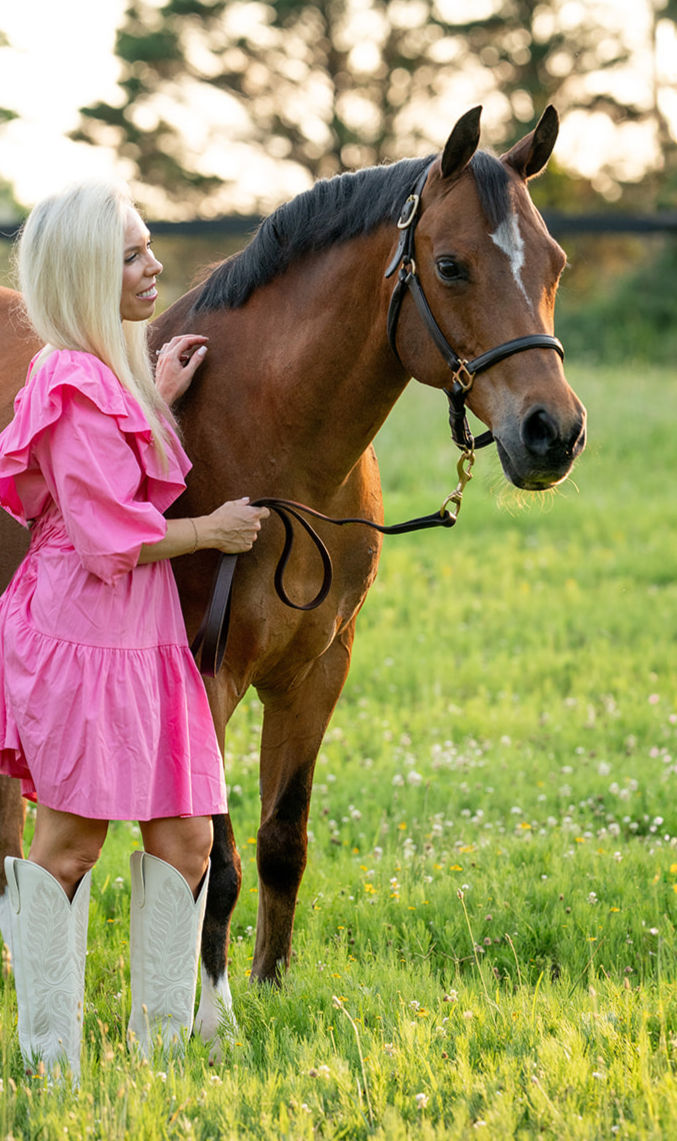
Here I am with 3/4 Arabian gelding JAG Khasanova scratching his shoulder and wither area and standing safely off to the side. Note I also have the lead rope folded in my hand - not wrapped around my fingers. It's important to stay aware of your posture and get to know the horse. Over time, you'll learn what each individual horse prefers and there will be nuance in how you interact with horses as you gain experience and knowledge! This was during a photoshoot with Sweet Fresno Photography/Erin Wheeler. Photos of people kissing their beloved horses' noses are so touching and sweet, but many horses may not appreciate a stranger doing this. Some don't even appreciate their owner doing this! With a horse you are not familiar with, please be safe and get to know them before your start randomly face smooshing or grabbing. I have to remind myself too so you are NOT alone in this! Humans are naturally "handsy" just like horse's are "nosey" - it's how we explore and get familiar with the world! Furthermore, please keep in mind of this when a horse is stuck in cross ties - they cannot walk away and say "No" so you may think "Well he loves it!" Unfortunately in cross ties (or straight tied) the horse really does NOT have much free choice in the matter as they cannot walk away. If you aren't familiar with the colt, stallion or gelding game of "bitey face" it can look pretty aggressive to a human viewer, but often boys are usually having a blast - at least with domesticated geldings! In the wild "bitey face" between full grown stallions is often accompanied with some more aggressive rearing and kicking (not a play fight) as a battle over some resource, although young colts will practice this all during play. In saying this, some domesticated boys may actually think that's what YOU are actually asking for and you've now started a game of "bitey face," possibly unintentionally, with a horse. This is NOT to say that some horses don't absolutely LOVE their faces scratched or rubbed - behind the ears, or between the cheek bones or really any sweaty place on their face that they wouldn't be more than happy to use you as their scratching post. I just find this topic important to address with newcomers who may lack of situational awareness as well as understanding of equine behavior and anatomy that more experienced equestrians may have. Horses are horses and it's only fair that you are aware of human tendencies that put a horse and human in a less than favorable or safe situation that can EASILY be avoided with a little education and awareness. Certainly we have to do uncomfortable things to horses - treat wounds, trailer them, teeth care, shots, de-worm, medical exams, etc. - and training comes into play so they are as comfortable as is possible with the process, especially in an emergency. Please just consider if you are not the trainer, horse's owner, vet or equine professional doing treatment or training with the horse, leave the unintentional poking and prodding of faces to the professionals. Vet Care Training is a great resource for equestrians, horse owners or professionals to positively prepare and train their horses for less than fun medical or emergency procedures!
You don’t have to buy anything NEW except a properly fitted, safety rated helmet! Besides a helmet which should be new, try to buy used and save some money. Please be on the look out for sales around holidays. Track prices. Please be certain the equipment on you and your horse fits properly! This is a sport and to be comfortable to do the fitness work, the equipment should fit well and correctly…including your horse’s saddle. It absolutely does not have to be fancy and brand new! You absolutely are able to find good quality and used. Do you really need to spend $400 on a new pair of tall boots or could you use that extra money saved for a few extra much needed lessons? Finally, please don't forget to clean/maintain your equipment daily and do a monthly or yearly deep clean - that is how you keep things lasting for years and years to come.
Treat your helmet like gold. Don’t throw it around or leave it on the ground. Dropped it on the barn floor? You probably need to buy a new one. Your helmet may save your life one day! Please don't forget to store your helmet properly as well.

28-year-old Purebred Arabian mare CA Destiny Gro+ and owner Kathy get preparing for their Dressage Foundation Century Ride with the help of Jessica and myself. It's a team effort! If you are just starting to ride, have been out of the saddle for a few years, or are still in the first year or two of learning to ride, you should have at least 10 - 15 lunge line lessons under your belt. Ideally the first 5 - 10 rides are on a lunge line so you can learn to develop a balanced, independent seat before being handed the reins. This is such an important foundation! If your trainer hasn’t done this, find a better trainer OR advocate for your proper education! If you skip the foundational basics now, you will regret it later, and most likely the unfortunate horse is also the loser in this lack of proper basic education.
If your horse is being caught, lead, groomed, and tacked up for you and taken care of by someone else after a ride, you are missing pivotal education to be a proper equestrian. This is what some call a “princess package” and you are not learning good horsemanship. If you cannot tack up mostly by yourself (with supervision or some assistance is of course needed the first few lessons and safety checks before mounting up until you've got it down pat!) and are allowed to ride on your own, this is a major issue. Being an equestrian is learning to do ALL the processes involved with horses. There is a difference between being “just a passenger” and good equestrian. The gap between a "rider" and an educated equestrian that knows good horsemanship these days seems to be getting wider and wider. Again, if your trainer isn’t teaching you all the ins and outs of good horsemanship, please be certain to request to learn specific topics or add another trainer to your list of people you take lessons from. Open up the conversation! This is a good time to ask the trainer who their mentor(s) are and who they continue to learn/takes lesson with themselves. If your trainer isn't willing or able to recommend additional learning resources, please consider it a red flag.

Please seriously consider getting yourself a neck strap (goes around the horse's neck) and/or grab strap (attaches to the D rings of an English saddle) to use for lessons if your trainer doesn't provide one. Label it with your name just in case you forget it at the barn after a lesson, but use it on the horse you ride in the lesson. Save your horse from pain and use it for your benefit, if needed! You should not be using reins or the horse’s mouth for balance. It also wouldn’t hurt to get a safety vest as well if it’s in the budget.


Learn a little bit about equine anatomy, biomechanics, fitness and behavior. Some quick notes: Horses continually produce stomach acid so they are meant to gradually seek out food and graze/forage the majority of the day to prevent acid splash or build up. The forage in their stomach acts as a buffer to the acid and saliva from chewing acts as a lubricant and antacid, reducing stomach acidity and protecting the stomach lining - both help prevent stomach ulcers. Horses are also meant to gradually walk hundreds of miles every week in the company of a herd, which keeps them safe from predators. The 6 Fs: Friends, freedom, forage, comfort, safety, and fun are the basics of equine welfare. Horses are mostly forehand heavy (60% - 75% in some studies - the horse's head is about 10% of its body weight!) so the key with fitness development is to help them be more balanced and this is even more important when you add the weight of a rider and saddle. Structurally, horse's aren't "made" to be ridden so we have to physically develop them to be able to properly support the weight of a saddle and rider. Horses, like humans, also have natural asymmetries and one way will often be a little more supple and balanced than the other. It’s our goal as we work with them to help them become more balanced and fit to be happy and healthy athletes for many years to come. If your horse is a little slow to that trot transition or slows down going up that steep hill, please consider their balance and fitness as well as your own balance! This is where ground work and cross training is so important for our equine athletes. Also, please be certain your horse gets a solid 10 - 15 minute walk warm up and a solid 5 - 10 minute walk cool down. Horses look to us like big strong animals, but for them to work hard and stay healthy (and happy), especially when being ridden, we do actually have to make sure they are in a consistent and correct fitness program. Please don’t let your eyes deceive you as you see this big and powerful looking animal - they have bones, muscles, ligament, tendons, fascia, etc. and cardiovascular health that has to be developed to do the work we want them to do!

Preparation is key, but it will take time to learn how to “plan ahead.” This is not about being anxious or absolutely not about being a perfectionist - it’s about thinking about 2 - 5 steps ahead of your horse if your goal is mutual understanding. Your horse is simply not a mind reader. If you want something specific, you will have to plan to communicate it and then execute the communication clearly. Horses generally go with the flow or make an educated guess on what to do next using their own thought process - usually what brings the most comfort or safety to the horse. Your horse LOVES that one really lush grass patch next to the barn? Practice up and down head cues in the stall or arena, teach "wait" and "graze" on verbal cue, practice positive reinforcement with food in the stall and a feed bucket or in a food pouch in the pasture when you go catch them, and correctly lead/walk in hand no matter where you are while also regularly practicing halt/walk/halt transitions in good posture everywhere you go so your horse clearly understands they are supposed to keep walking. Want to do a trot transition at the cone at the end of the arena from the canter? Start your preparation for the downward transition to the trot 10 canter strides out (pick a fence post or something as a visual guide - could be a tree outside the arena or a pole on the ground) and then ask for the trot 5 canter strides out. You will be able to shorten the preparation time frame as you and the horse practice, improve communication and become more balanced…but give yourself time to prepare and your horse time to respond! Became an unexpectedly hot or rainy day at the barn? Plan to always have a water bottle and a rain coat in the car ready! Same with bug spray, sunscreen, a sun hat, extra layers, gloves, mud boots, handwarmers, etc. This, of course, will depend on where you live! I like to have a bag, back pack or box in my car if extra supplies are needed. This is how you know you are becoming a true horse person when you can look in your car and see equestrian related supplies! ;)
I'm going to end this section with a bit of a contradictory statement: Yes, you do need to prepare and, if you have a goal, have a plan. A daily management/care plan, a work session plan...weekly and monthly plans will help you reach those short term and long term goals (if you have any). HOWEVER, please do not be afraid to deviate from the plan as/if needed. Please don't hold onto a plan as if it is set in stone. Think of it more as a flow chart - you may end up taking different paths to reach that final goal (whether it's a certain exercise in that moment or a goal 6 months out). We all have "bad days" here or there. Please don't expect 100% from you or your horse all the time. I like to think 70% effort on most days and some days when you or the horse is hot or tired, you may both only be at 50% effort. Find a balance that keeps you and your horse mentally and physically healthy. Some days your WARM UP will be your ride and that is completely OK! Depending on what the plan is, it may take an extra few minutes or a few weeks or a couple years. This is a quote I often keep in mind: "The definition of insanity is doing the same thing over and over again and expecting different results." It's not to say that reviewing the basics and getting the foundation solid is not important, but in the moment a small posture change from you, approaching the exercise differently, getting that saddle fit session that you've been putting off, coming back to that exercise another day, or even making a management change for your horse (like more turn out time or balancing their diet), may yield a better response since your horse understands what you are asking better, they are able to be more balanced and comfortable, they are happier in general, etc. If anything, horses will at the bare minimum teach us the importance of adaptability, patience and critical thinking. Our goals are not our horses' goals and they have their own strengths and weaknesses just as we do. Remember to enjoy the process and relationship building aspect of the sport! Recognize as with anything worth doing or any relationship worth having, there will be some set backs and challenges.
Timing in communication is important. Whether you use negative reinforcement (using pressure/release to reinforce a behavior - you are taking away the pressure) or positive reinforcement (using reward to reinforce a behavior - you are adding a reward), timing is everything. Yes there’s more on top of just knowing the posture you and your horse should be in, the verbal cue/verbal aid, or physical cue/aid. I know it's a lot when you get in the thick of it and start learning it all! The release of pressure is what reinforces the behavior in pressure and release, but I see a lot of people just brace and get into a pulling and pushing match for no reason and the horse just stands their confused or shut down. As a tip, if the aid/cue isn’t working even with a clear release or clear positive reinforcement, completely change what you are doing (your posture, cue, etc.)! Take a few deep breaths, take an outsiders point of view of the scenario for a few moments, and don’t keep repeating the same thing and expecting a change. Of course, make sure to chat with your instructor what you could do differently next time as well so you have a few alternatives in your box of communication skills.
Riding aids - do you use your voice first, then seat, then legs and then hands? Or do you incorrectly rely mainly on your hands to ride? Many horses do really well with a clear verbal cue first. With the majority of horses, downward transitions mostly require you to sit deeper on your seat pockets and close your thighs. How does your horse do with just walk and "whoa" / halt verbal cues on the ground? Do you practice this regularly while leading them around to and from the barn or arena? What about walk-trot transitions in hand on the ground? Are you able to you do the same thing in the saddle without solely relying on rein aids? See how little rein aid you can use to get a walk-halt transition under saddle! Once that's going really well, practice trot to walk with as little rein pull/release (half halts) as possible and more on voice/verbal cues and seat.
Horses won’t get offended by boundaries if you stay fair, clear, and consistent. Boundaries often keep us all safe and some owners/trainers have different boundaries with their horses than others. But this doesn’t mean it’s a dictatorship or about dominance. If your trainer touts "You need to be boss” or “I would never hand feed a horse food” it’s more telling about their lack of education and training than the horse. There is a difference between setting clear expectations and training (you and/or the horse) versus being reactive and passive. In the beginning stages black and white boundaries DO help YOU with safety and clarity, but nuance will come with time! I can clearly tell my horses something I may usually be just fine or happy with, but tell them “Not today” with no hard feelings for anyone (horse or human) involved. This is where the science of horsemanship melds into the art of horsemanship.
Please know that riding and showing is absolutely not the end all, be all. And it absolutely is NOT the starting point. There is so much more to horses than just riding if for some reason finances prevent you from getting regular riding lessons. IF you are looking for financial help for learning, please consider applying to all the training scholarship and grants available! Just a few to apply for: Keystone Arabian Riding Experience by the Arabian Horse Promotional Fund Georgia Arabian Horse Association Youth of the Year Award The Dressage Foundation: Grants and Programs Georgia Dressage and Combined Training Association Volunteer of the Year US Equestrian Grants and Scholarships The Arabian Horse Foundation Scholarships Arabian Horse Association Youth Resources Riding for quite a few individuals that own their own farm and horses is more like a plus rather than an often occurrence. Care and barn chores always come first. If you are skilled enough, you may be able to get some free riding time at a farm with too many horses and not enough time. For example, we have been offering a free riding opportunity for over 20 years now. With up to 18 horses at one time (currently at the time of writing we have 9), we didn't and don't always have time to work all the horses, especially between barn chores at our private, family farm, working full time to pay for our beloved horses' care, and normal life to-dos.
It also may be well worth getting some good instruction on long lining and classical in hand work and practice your communication, posture and aids on the ground. Maybe you aren’t an experienced enough rider someone is going to let you ride their horse without being in a supervised lesson with a professional, but you could volunteer at horse rescues or reach out to horse breeders where you can practice your ground work and get more regular hands on experience horses. Then you can apply what you have been practicing on the ground to your occasional riding lessons that you are able to afford. Also, remember many people spend MONTHS or even years working with horses on the ground to get them ready or started under saddle, to finish their training, get them riding fit after time off from a fitness program, keep a senior horse fit and mobile that can no longer be ridden, rehab after an injury, or retraining the horse after a traumatic experience. Furthermore, cross training weekly usually includes 1 - 2 days of ground work for a horse. So if you are not getting saddle time 4 - 5 days a week, please don't hesitate to put some time into work outs at home (or the gym) AND handling/ground work with horses instead. You will still be learning and doing so much! There's pretty much nothing that can be done under saddle that you cannot do with a horse on the ground - from piaffe, passage or jumping or walking or trotting the trails (in hand or safely long lining/ground driving). Furthermore, equine clubs and associations ALWAYS love and need volunteers. Reach out to your local horse clubs and see who needs volunteers and how you can help out to scratch your equine itch a bit more if your finances are spread thin! The Georgia Arabian Horse Association and Georgia Dressage and Combined Training Associations are two local clubs that are always looking for volunteers. This is a great way to learn more. Volunteer to scribe for judge for a weekend and you will learn a lot! Feel like you are missing out with the challenge of shows? Again, volunteer at shows and do virtual horse shows or at home tests! Pick through hundreds of patterns/tests from ranch riding, hunter seat equitation, trail in hand and under saddle, reining, dressage, etc. to practice at home and set up a new pole pattern or obstacle course every week or every other week. You will never be bored or lack a something new to practice or learn! See number 20 for a more on this topic.

3/4 Arabian gelding JAG Khasanova demonstrating the "straddle the pole" exercise while wearing a properly fitting lunging cavesson and sporting some Kinesiology Tape to work on his core stability awareness. If you find the barn you are riding at has most horses in twisted wire bits or a lot of harsh gag bits or a lot of horses with supposedly “hard mouths” - ask why? Are lesson horses being schooled occasionally by more experienced riders or even better, the/a trainer/professional? Do they respond well to voice cues on the ground? Do they have properly fitting saddles? Do they get cross training or body work? Are they lunged off the bit (reduces mouth sensitivity because it causes excessive pressure and is often one cause of a "hard mouth") or are they lunged in a properly fitting lunging cavesson? If you find you are not getting clear explanations as to WHY, please re-consider your choice of trainer/farm. I personally don’t mind short shanked rubber Pelhams or double bridles or short shanked hackamores with sheepskin noseband/cavesson covers, for advanced riders/horses, but for beginners I prefer to see bitless bridles. If tight standing martingales, draw reins or tie downs are being used at the barn, I would seriously consider finding a new barn to take lessons at. You decide what’s most ethical for you. This will probably change over time as you train your eye and learn more. All in all, please try to keep equine welfare at the forefront.

JAG Lady Pegasus+/ wearing a sidepull (bitless) bridle with sheepskin covers for comfort while being ridden by beginner youth rider and my cousin's daughter, Marilyn. This was her second ride ever! 
Image of a twisted D ring snaffle bit from Google - a bit I would personally not want to see on a horse! A big beginner issue I see is leading issues - walking ahead of the horse (instead of at the neck or shoulder) so they cannot see the horses’ expression (eyes, ears, nose, mouth, direction neck is bent) and are too far ahead to effectively maneuver the shoulders or hind end/haunches. Not only does this put you in a position for getting walked on or if the horse trips, being run into, oftentimes the handler ends up dragging the horse along and pulling them so far on the forehand the horse is forced to stop to catch their balance. It's also much more difficult to be aware of what your horse is thinking or doing if they're way behind you! Add on that many continue to puuuuuullll on the horse non-stop with no return to neutral or release of the line (whether lead rope or reins). This is very much a wheel barrow scenario - the weight has now all been transferred to the front of the wheel barrow and you have two possibly scenarios - the wheel barrow runs away out of control because its so front end heavy OR it's so heavy it tips forward completely forward and stops. This is why knowing a bit about equine anatomy and biomechanics really comes handy! Not just knowing the HOW to do XYZ, but the WHY can bring whole new insight and a better approach.

Here I am walking in step together showing a neutral leading posture at JAG Khasanova's shoulder. "Khody" is wearing an English bridle with a mullen mouth plastic snaffle bit in this photo. You are able to see I have taken the bridle's reins over Khody's neck and I am holding the reins flat in my hand - not wrapped around my fingers - with a light contact. In this position, I am able to see Khody's expression (ears, eyes, nose, head position, etc.), I am in a position to more easily maneuver his shoulders, hip, etc. and am able to more efficiently move ahead and behind him as needed. If you find yourself in this scenario where the horse slams on the breaks first off change your thought process - think about what you want them to DO rather than what you don't want them to do. This can head off this scenario in many ways while you are leading. How do I maintain a good walk rhythm and reinforce the walking forward behavior I want? Remember, have a clear plan and execute it and be PROACTIVE. Think 2-5 steps ahead without literally leaving your horse behind. ;) If you are already in the situation where the horse has halted... A) Remember, every pull (or push) should be followed by a clear release [negative reinforcement]. The pull should last a second or two or three at most. Consistent (never ending) tension is only going to cause your horse to become numb or dead to the pressure or brace against it (you will see very tight lower neck muscling sometimes when this happens). No one - you or your horse- should be getting into a game of tug-of-war. You are able to repeat the pressure/release a few times, but it needs to be done with awareness that the use of the pressure/release is correct. Is it cohesive with our body language and verbal cues (both are also communicating walking forward) and the timing of the pull/release is correct. The majority of time while leading you will mainly pull/release either sideways OR upwards (for example, re-balancing half halt). If you have a tendency to or habit of pulling downwards or forwards, re-think if this is really what you are trying to communicate and if its useful cue at this moment in time. We may, of course, half halt (pull/release) backwards to cue for a stop/halt, but that is not the focus on this section. But this is a good time to please keep in mind if you are pulling backwards or have a tight line, you may be in fact asking the horse to halt/not move and not allowing them to move forward. B) Look at where you are in space with the horse. Are you trapped next to a fence or is there a big tree to your left? Turn your horse in as big of a partial circle as possible one way or the other (ideally away from your toes/feet if at all possible so you don't accidently get stepped on) - just a few steps side ways is usually plenty, but a half circle if there’s space is perfectly fine, if needed. Do this by either turning their head in the direction of the turn/circle while standing at their neck or shoulders while adding the proper walk verbal and postural cues. For example: For my horses I would use the verbal cue "cluck" & "walk" and then the word “turn” and some pressure/release with my hand at at the shoulder with the horse’s head in a slight bend the direction of the turn. I could even press and release at the girth area where my leg would be while riding. After the half turn/step(s) sideways or even some crooked steps on the partial circle results in a confirmed/solid walk NOW use this forward momentum to move forward the direction of the destination you wanted originally. Keep the walk marching forward (active) and look where you are going without leaving the horse behind in the dust. Reinforce walk if needed using the verbal cues the horse is trained to know. OR C) If the moving sideways doesn’t “unstick” your horse from their braced under neck (Learn about the horse's “stay apparatus” here and here and here) or heavy forehand (probably now 75%-80% on the horse’s weight is on the front half of their body), consider asking for the horse to shift their weight backwards to rebalance themselves. It doesn’t necessarily need to be 2 - 4 steps backwards! If you can clearly see them shift the majority of their weight to their hind end without even a full step back, then quickly ask for a half or a full step sideways (ideally away from your feet/toes). This should be more from a position of you standing at the neck/shoulder area of the horse. Once you get a slight step sideways, then cue the horse to walk forward towards your "destination." This may require some good coordination on your part as it may happen within 40 seconds or so! The goal is to re-balance the horse so they can ultimately move freely forward. This should, hopefully, also unstick your horse from the spot you both found yourself in!!

Leading JAG Khasanova in a halter and lead rope this time showing "neutral" leading posture. Note the lead rope is not wrapped around my hand for safety reasons and I have light contact on the line until I need to provide more guidance. Please video yourself whenever possible! If you have a tight budget or just want to improve as much as possible as quickly as possible in your partnership with horses, video as many sessions you are able to with your horse. This means if you paid $65, $75, $130, or $300 for your lesson or clinic ride, you now are able to rewatch that lesson as many times as needed to learn from it increasing the value of your investment. Take written notes and even compare video to video from months or weeks previous. Then you are also able to celebrate your progress - whether big or small! Please don’t forget to video yourself leading, lunging, while doing other ground work, etc. as the communication and balance on the ground will directly impact your riding as well as your relationship with the horse. The PIVO Pod product is a fairly reasonably priced Auto Tracking For Equestrians. It's not perfect, but is a wonderful option if you don't have someone to video you during your work or riding sessions. It connects to smartphones via Bluetooth and the Pivo app. Almost all other sports use video evaluation to improve performance, why would we not? If you or the horse are struggling with a certain exercise or you don’t often have a professional or mentor for “eyes on the ground” feedback, video is even more important. Communicating with horses is a lot about timing, balance, and posture and videos often are eye opening and offer an opportunity to positively transform your relationship with horses!
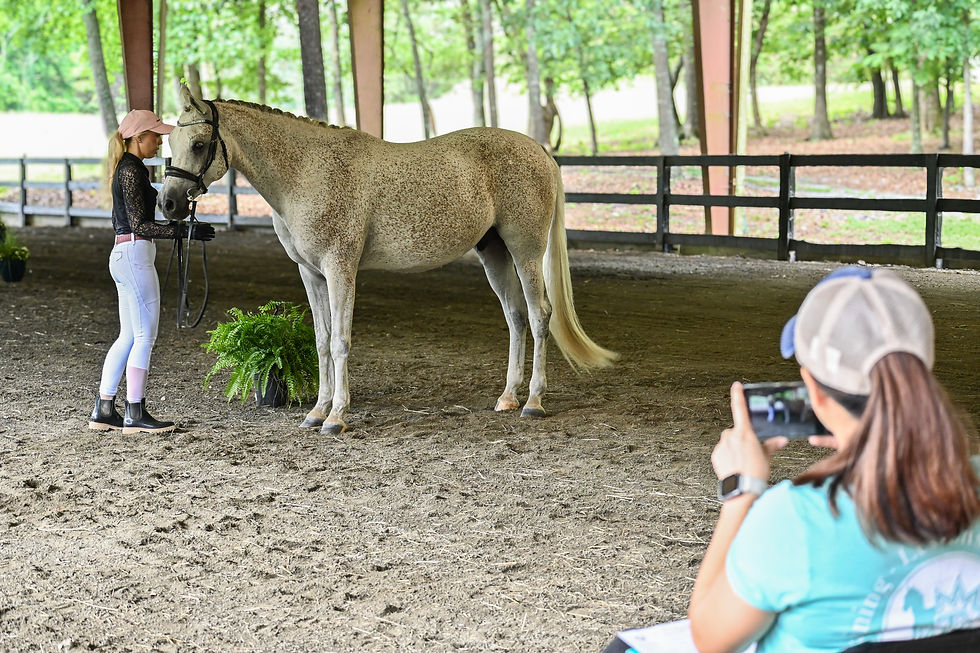
My friend, Jessica N., kindly videoing my in hand work with purebred Arabian gelding Enzos Inspiration at an educational demonstration so I am able to review the video later. Practice doing as much as you can from both the right hand side and the left hand side. If you lead mostly from the left hand side, please be certain to switch it up to where you are leading 50% from the right hand side and 50% from the left hand side every time you are at the barn. Not only will this improve your horse’s balance and straightness, you will improve your own balance, straightness and coordination, which will have a positive impact not only in your riding, but also your day-to-day life! This may be awkward at first for both horse and human, but take this transition gradually and you will both reap the benefits.
Please don’t forget about caring for the horse you are working or riding. Maybe they’re not your favorite lesson horse or maybe you only ride once a month. You can STILL be a fair or even positive influence on this horse and their life - even if it's only for a couple of hours. Communicate with your trainer to be certain they get appropriate water breaks, that they have hay and water before your scheduled lesson, apply anti-fly spray before a lesson so they can stay focused and not get bit by bugs, apply anti-fly spray after they’ve been cooled off and go out to pasture in the summer or spring, figure out what brushes are their favorite, be certain they are cooled down properly with a cool water rinse off on a hot day, kindly put the saddle and bridle on so they are comfortable, etc. Horses don’t get to choose their lives, their owners, who rides them, how they are treated and fed, so first off it’s important to pick a farm to ride at that takes correct care of their horses, but also that you bring something to the table to the relationship to the best of your current ability and limitations within the program. If you are eager to do better & learn more, have you asked your trainer if they would host a clinic or group lessons on how to do proper stable based exercises or maybe the basics of proper saddle fit, bit, and bridle fit? A short demo and educational season in simple/basic body work (Perhaps the Masterson Method Light to the Core type work)? Could you do ground work lessons occasionally with your lesson horse to improve communication, fitness, balance, and a build a better partnership in general?

Professional trainer Samanatha R. of Georgia Sport Horses, LLC teaching and answering auditors/visitors' questions at our fundraiser educational event hosted our private family farm J.A.G. Arabian Sport Horses. Please do NOT rely on a once a week lesson to teach you everything you need about horses and riding. Audit clinics for cost effective all day learning. Watch the warm up ring at shows. Read books. Ask to watch a friend’s lesson. Ask to shadow your trainer and write down your questions to ask later. Short on time? Listen to equine podcasts, equine courses/webinars/videos, or an equestrian related book on Audible in the car while driving to and from work or put some head phones in to listen while doing laundry or dishes or cleaning house! I usually recommend one book about the following: - Equine fitness, biomechanics, anatomy (Personal Suggestions: A book or two by Gillian Higgins of Horses Inside Out and Jec Aristotle Ballou or Dr. Hilary Claytons' book Conditioning Sport Horses or Physical Therapy for Horses by Helle Katrine Kleven) - Equine care, nutrition, tack fit, general horse knowledge, etc. (Personal Suggestions: United States Pony Club books, Connection Training: The Heart and Science of Positive Horse Training by Hannah Weston and Rachel Bedingfield, Dressage in Hand: What Horses Want You to Know by Josepha Guillaume) - Rider seat, aids, equestrian mindset, etc. (Personal Suggestion: "Centered Riding" by Sally Swift or a newer edition) - Equine brain or behavior (Personal Suggestions: Horse Brain Science: The Neuroscience of Ethical Horsemanship by Dr. Stephen Peters or if you want more scientific, Equitation Science) - General Training Knowledge (Personal Suggestions: Riding in Release: A Practical Guide to French Classical Equitation and Horsemanship by Kate Del Sandel, How Good Riders Get Good by Denny Emerson, and add on at least a classical book or two by Charles de Kunffy, Walter Zettl, Alois Podhajsky, Udo Berger, etc. If you can get our hands on a reasonably priced book by Phillipe Karl or Anja Beran, that would be wonderful!) I am also a huge fan of Amy Skinner Horsemanship and Rudy Horsemanship for those that feel like they aren't progressing or don't quite have the basics down. Both cover a lot of basic skills via videos, courses, and/or written posts/blogs (and also offer virtual video feedback or lessons!) that I feel are important, but not explicitly stated to beginners or in a way the average horse person can understand and apply. There are SO many incredible resources out there! We have a lot more listed on our Resources page and I will often share many other educational resources and a "book of the week" on our farm's Facebook and Instagram social media pages so please be certain to follow those as well. If you have expectations and goals you want to reach, please do not blame the horse, do not blame your trainer, and do not blame the world if you won’t do any work learning outside your lesson/riding/barn time. Improving DOES require a bit of homework. And YES - saying you “just want to go on a trail ride” or ride bareback one day (without falling off) is a GOAL. If these are specific goals you want to achieve, clearly communicate this with your trainer and ask how you can reach these goals. Discuss steps and estimated timeline to make certain proper expectations are set. It may include more time/financial investment of a few more lessons a week and some at home work outs. If you don’t want to dive “all in” and only want to do horses as a side hobby for fun, that is totally fine! Simply appreciate the time you get to be with horses and/or are learning something new or working on yourself each lesson! There’s something to say for that as well. :) I am absolutely all for just enjoying the generosity of horses and simply being in their presence.

JAG Kalico Kid+// confidently and carefully going through water and through squishy sand and rocks on a trail ride. Horses cost a lot to care for and maintain - time and finances wise. A "pasture puff" horse that is basically living the retired life versus an active equine athlete can be a big cost difference as well as taxes, insurance, equipment, pasture and barn maintenance, etc. depending on geographic location. If the horses get lots of turn out with buddies and 24/7 slow access to forage, but there’s no chandeliers hanging in the barn and Olympic level footing in the arena, that’s perfectly OK. It shows that the farm is putting money to where it should be - the horse’s care and not purely for the “humans' gaze" or convenience. If you have to walk 5 - 10 minutes to catch your horse out in the pasture or your horse is out on a dry lot with multiple hay bags, instead of locked in a stall all day - be very thankful. If your trainer is going to shows every other weekend or buying $8,000 saddles that don’t even fit the horse or the client lounge is the epitome of pristine comfort and always stocked with snacks, but the horses are without hay for 3 hours and every horse is cross tied for every rider like a straight jacket then you have an issue. Horses are fuzzy and fat during the winter? Perfectly acceptable! Body clipped, but for some strange reason have no top line muscling even though they’re ridden consistently 5 days a week? An issue in my book. A poor topline for a pasture puff/out of shape 25 year old senior is acceptable, but not a horse ridden by a competent rider regularly 5 days a week (as long as they don't have lordosis). Do they have some place dry to get their feet out of the mud for at least a few hours every day and also get protection from the elements if they choose to (like a shed)? Then that's good! This is where you really have to draw the line between what is best for the horse and what is simply about human convenience and then the next question - which business would you rather support? The one that treats their hard working horses the best they possible can and offers a safe and positive learning experience or the one that caters solely to humans' convenience and ego?

Samantha R. of Georgia Sport Horses, LLC and JAG Khasanova demonstrating how to use stability/balance pads/mats with a horse to a group of auditors/guests at one of our fundraiser educational events. I highly recommend after taking lessons weekly for at least a year and before jumping into horse ownership, seriously consider leasing a horse. This prepares you for the financial and time commitment of owning a horse. Perhaps just start by doing a partial or half lease and if this works well, then do a full lease for a few months. This also helps and gives you enough time to determine what horse you NEED and not necessarily what horse you want. Do you want to pursue ranch riding competitively on the National level or do you want a jack of all trades type horse that can do everything from trail riding, to low level shows and bareback fun rides and maybe do a little English this week and a little Western next week? Also, are you able to commit to working your horse 3 - 5 days a week or would you need to hire a trainer to school them 1 - 3 days a week to keep them riding fit or would even have to lease out your horse as soon as you bought it as well? I would do your best to treat the lease like a test run for ownership AND use it as an opportunity to learn more. Try to be there when the vet, farrier, dentist, or massage therapist is there for your lease horse so you can at the very least observe and learn, even if it's not hands on learning. Even if you cannot be there for every single appointment, this is a fantastic way to be a better educated equestrian and future horse owner. We offered off site and on site leasing for about 20 years with our privately owned family raised and trained horses, especially when we graduated college or while in college and we could only bring 1 or 2 horses with us at a time. We had a barn full of incredible schoolmasters with many hours of trail riding and countless shows under their belts that gave so many beginners the opportunity to learn to ride and, if they chose to, show without owning a horse. When a lease is arranged properly with a detailed contract and open communication between the parties, everyone benefits. The key is ensuring the horse is well taken care of during the lease and returns from the lease happy and healthy. Most first horses for beginners are in the 15+ range and may need a little arthritis maintenance or PPID/Cushings care as they reach their 20s, but that reliability, patience, and incredibly forgiving nature (of our mistakes!) comes with years of training and experience. This horse or pony is what is called a "schoolmaster" or what I like to call the unicorns of the horse world. A little extra health care/maintenance for your safety and the "no worries" riding experience is often well worth it! Of course, please do not forget to get a thorough Prepurchase Exam (PPE) from a vet of your choosing before buying a horse. This is not about a PASS or FAIL, but what you are willing to take on and obvious information gathering about the horse. Having your vet take basic hoof and hock x-rays are not a bad idea during the PPE.
FINALLY, after reading all this by now you probably realize horses are unique individuals as much as you and I. I think it's just important to understand that by NATURE horses seek stability, comfort and cohesion for safety. Without being a cooperative team with good understanding of one another, they wouldn't survive. They work together as a herd to find water, food, and protect one another. One horse senses danger, everyone comes together to run away. Another horse decides they're thirsty and goes to seek out a water source, the rest will follow. They are natural energy conservers because wasting energy on unnecessary activities other than those meant for survival (reproduction, eating, drinking, socializing and playing to bond and learn communication, fleeing from danger, etc.) means depleting themselves of essential energy. To learn more about this, I believe every equestrian should read the book "Horses in Company" by Lucy Rees. She also has a free webinar on this topic that would be a good add on. In saying all this, we as humans can certainly bring more to our horses' lives in domesticated settings and horses often can find many positives in our interactions with them. Most horses are very curious and will leave their herd or food to come say "Hi!' We can hone in on their curiosity and sense of wonder and build their confidence in our strange human world or we can accidently or intentionally shut this down or even cause them to be anxious or stressed. With the help of a good mentor and professional/trainer and some homework on your end, you can absolutely become a cohesive and happy team with a horse. Even a challenging work session that was definitely not on their to do list that day focused on balance, good posture, good joint health, and maybe a little much needed safe weight loss for those chubbier horses, absolutely can be done if you bring a sense of play, variety and a good dose of positive reinforcement for motivation. A "work session" can be life enriching and good for their health if done correctly and with a proper plan in place - a fitness program starting from on the ground and up, warm up, cool down, quit before horse gets sore or fatigued, etc. If you REALLY do it right, a work session to you may be a play session for them! ;) Correct movement is medicine and walking is physical therapy in many situations. The horse and human relationship is so unique as horses are so amenable despite being so large that we can have such nearly "magic seeming" partnerships despite being completely different species. It is absolutely awe inspiring and absolutely something we should never fail to acknowledge and respect! We are lucky to have the opportunity to have them in our lives!
Hope these tips are helpful or insightful or at the very least, worth critically thinking about. What would you add? If you could "go back in time," what would you tell yourself when you were just starting getting into horses? What you thankful for when it comes to horses and the mentors in your equestrian life? - Written by Megan Gilker Thomas. Megan is very passionate about the Arabian Horse, education and the ups and downs of a busy amateur life with horses. She understands the journey and stages that one goes with horses at different points in life wants to share her experiences (and mistakes) with others so they don't have to repeat them! She is an Arabian Horse Association Rider of Excellence, USDF Bronze Medalist, and the 2018 Georgia Arabian Horse Association President's Award recipient for her volunteer work. In 2017 she was Nationally Ranked 8th place Arabian Horse Association Adult Amateur, 1* Rated Rider on Centerlinescores.com, and Georgia Arabian Horse Association (GAHA) High Point Awards Reserve Champion Equitation/Showmanship Recipient. Megan grew up in the 1990s - 2000s eventing with the Atlanta Pony Club, competing in open hunter & dressage shows, Welsh Pony shows, and Arabian shows, trail riding for fun for many miles and hours, riding bareback, and spending lots of quality time her horses - not just riding. She enjoyed the opportunity of learning from and riding 8 - 15 different horses a day! She helped raise and train several of her mother's homebred horses from the ground up for the trails and show arena as well as rehabbed/retrained several purchased projects. While in college 2006 - 2009, Megan competed on the Intercollegiate Horse Shows Association (IHSA) Berry College Equestrian Team for 3.5 years until she graduated early. Megan competed in Open Hunt Seat Equitation and then all the way up to the National level in Advanced (Western) Horsemanship. Megan received her USDF Bronze Medal in 2018 earning all her needed scores on her beloved Arabian Horses: J.A.G. Cafe Au Lait+/, Conkar+/ and JAG Kalico Kid+//.


Comments